Tokyo's public transportation network is often cited as one of the finest in the world — punctual, comprehensive, and surprisingly affordable once you know how to use it. Whether you're commuting daily, exploring new neighbourhoods, or simply heading to a job interview across town, understanding the system will transform your time in this city.
The Rail Network: JR Lines, Tokyo Metro, and Toei
Tokyo's rail system is operated by three main entities: JR East (Japan Railways), Tokyo Metro, and Toei (the metropolitan government's transport arm). Together they operate hundreds of stations across the greater Tokyo area, and for most daily journeys you will use at least two of them.
JR East runs the overground and shinkansen lines. The most important for everyday use is the Yamanote Line — a loop line that circles central Tokyo, stopping at hubs including Shinjuku, Shibuya, Harajuku, Akihabara, Ueno, and Tokyo Station. If you only memorise one line, make it the Yamanote. The Chuo Line and Sobu Line run east–west through the city and are heavily used by residents of western wards like Suginami.
Tokyo Metro operates nine subway lines, including the popular Ginza, Hibiya, Marunouchi, and Hanzomon lines. These dive beneath the city and reach areas the Yamanote does not. Many commuters rely on the Tokyo Metro to access their workplace directly from residential neighbourhoods.
Toei runs four additional subway lines (Asakusa, Mita, Shinjuku, and Oedo) plus Toei buses and the Arakawa tram. Note that tickets are not automatically interchangeable between Tokyo Metro and Toei — if you switch systems mid-journey without an IC card, you may pay two separate base fares.
IC Cards: Suica and Pasmo
The single most important item for getting around Tokyo is an IC card. Both Suica (issued by JR East) and Pasmo (issued by the private rail consortia) work identically for practical purposes — you can use either on JR lines, subways, buses, and even at most convenience stores and vending machines.
IC cards eliminate the need to calculate fares or queue at ticket machines. Simply tap your card on the yellow or blue reader at the gate when entering and exiting, and the correct fare is automatically deducted. Top up (charge) your card at any station machine or at Lawson, 7-Eleven, and FamilyMart convenience stores.
Setting Up Your IC Card
- Purchase at any JR ticket machine or staffed window (¥500 deposit, returnable)
- Minimum useful top-up: ¥1,000 — for heavy commuters, ¥3,000–5,000 per week is typical
- Link to Apple Pay or Google Pay for contactless use on your smartphone
- The card works on buses, trains, trams, and monorails throughout Japan
- Refund your deposit when leaving Japan at major JR stations (bring your card and ID)
Tokyo's Bus Network
While less prominent than the rail network, buses are invaluable for reaching destinations between train stations — particularly in residential areas of Suginami, Nerima, and Setagaya wards, where station coverage is lower. Toei buses cover much of central and eastern Tokyo; private operators serve the western and southern suburbs.
Board at the front of the bus, tap your IC card on the reader, and tap again when you exit. Fares are flat within the city (¥210 for most Toei routes as of early 2026). Bus stop announcements are made in Japanese and English on most central routes, and Google Maps accurately shows real-time bus locations for major lines.
Navigation Apps
Several apps make navigating Tokyo significantly easier, especially when switching between rail operators or planning multi-modal journeys.
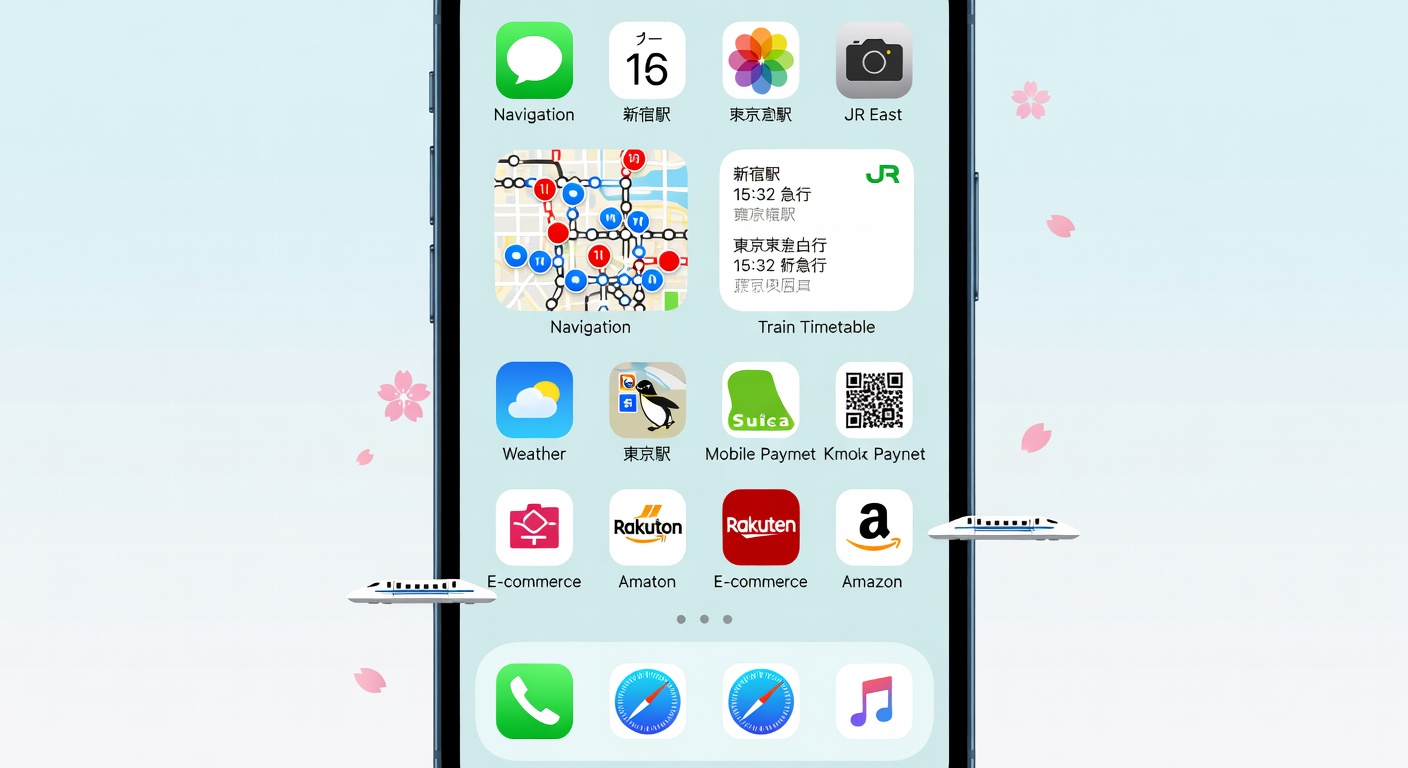
Google Maps is the most accessible option for newcomers — simply enter your destination and select "Directions" then "Transit." It shows departure times, platform numbers, required transfers, and an estimated fare. The walking directions between stations are also reliable. For more detail, Navitime (available in English) is widely used by locals and provides information on seat availability and express versus local services. Jorudan is another respected Japanese transit planning app with English support.
Taxis and Ride Services
Tokyo taxis are metered, clean, and safe, but notably more expensive than public transport. The base fare starts at around ¥500–600 for the first kilometre, increasing rapidly thereafter. Taxi doors open and close automatically — do not reach for the door handle. Payment by IC card and major credit cards is now standard.
GO is Japan's dominant ride-hailing app and integrates with regular licensed taxis. Uber operates in Tokyo but with limited driver availability outside central wards. Both apps allow you to pay within the app and share your route with contacts.
Cycling in Tokyo
Cycling is a practical and enjoyable mode of transport in quieter residential areas. However, Tokyo has specific rules: cyclists must ride on the road in most situations, not the pavement, unless a blue bicycle-lane sign is posted. Riding on pavements where prohibited can result in a fine. Helmets are strongly recommended (and required for children under 13). Bicycle parking is regulated — leaving your bike outside a station will likely result in it being impounded by the ward office.
Docomo Bike Share and Hello Cycling operate dock-based rental systems across many central wards. Day passes are economical for sightseeing, and stations can be located through their respective apps.
Rush Hour: What to Expect
Tokyo's rush hour is famously intense. Morning peak runs roughly from 7:30 to 9:30 on weekdays, with the Yamanote, Chuo, and major subway lines reaching extreme crowding levels. Evening peak is typically 18:00 to 20:00, though more spread out. Practical strategies include:
- Shift your commute by 30–45 minutes earlier if your work schedule allows
- Stand clear of the doors and move to the centre of the carriage
- Allow exiting passengers to leave before boarding
- Remove large backpacks from your back and hold them in front or overhead
- Priority seating (silver seats) near the doors is reserved for elderly, pregnant, and disabled passengers
Cost-Saving Tips
Tokyo transit, while efficient, can add up for heavy commuters. Some practical ways to reduce costs:
- Commuter passes (teiki): If you travel the same route daily, a 1- or 3-month commuter pass offers significant savings and is sold at station windows
- Off-peak travel: Fares are standard at all times, but trains are far less crowded before 7:00 and after 21:00
- Walk between nearby stations: On the Yamanote Line, many adjacent stations are less than 10 minutes apart on foot
- Tokyo Metro 24/48/72-hour passes: Unlimited rides on Tokyo Metro for tourists — available at airport stations and major hubs
- Day passes for buses: Toei offers one-day bus passes that can be economical for neighbourhood exploration
Tokyo's transport network rewards those who take a little time to understand it. Once you have your IC card loaded and a navigation app installed, the city opens up completely — from the distant suburbs of western Tokyo to the waterfront districts of Odaiba and Shinagawa. The system is an engineering achievement and a genuine pleasure to use, provided you go with the flow.